How Much Does a Paver Patio Cost in Canton, Ohio?
A professionally installed paver patio in Canton, Ohio costs $12 to $35 per square foot installed, and most complete projects land between $8,500 and $18,500. A simple 12×12 patio with standard concrete pavers sits at the low end. A large patio with natural stone, borders, steps, and a seating wall can run well past that. Those are real installed numbers — materials, labor, excavation, and base — not the teaser rates you see on national cost calculators that were written by someone who has never swung a plate compactor in Stark County clay.
I’m Jordan Filimonuk, owner of Fili Property Maintenance, and I’ve spent over 15 years designing, building, and maintaining landscapes across Northeast Ohio. Here’s how I price patios at my own company, so you have something firmer than a national average:
- Small patio — $4,000 to $8,000. Around 12×12 (144 sq ft). Standard pavers, clean rectangle, straightforward access.
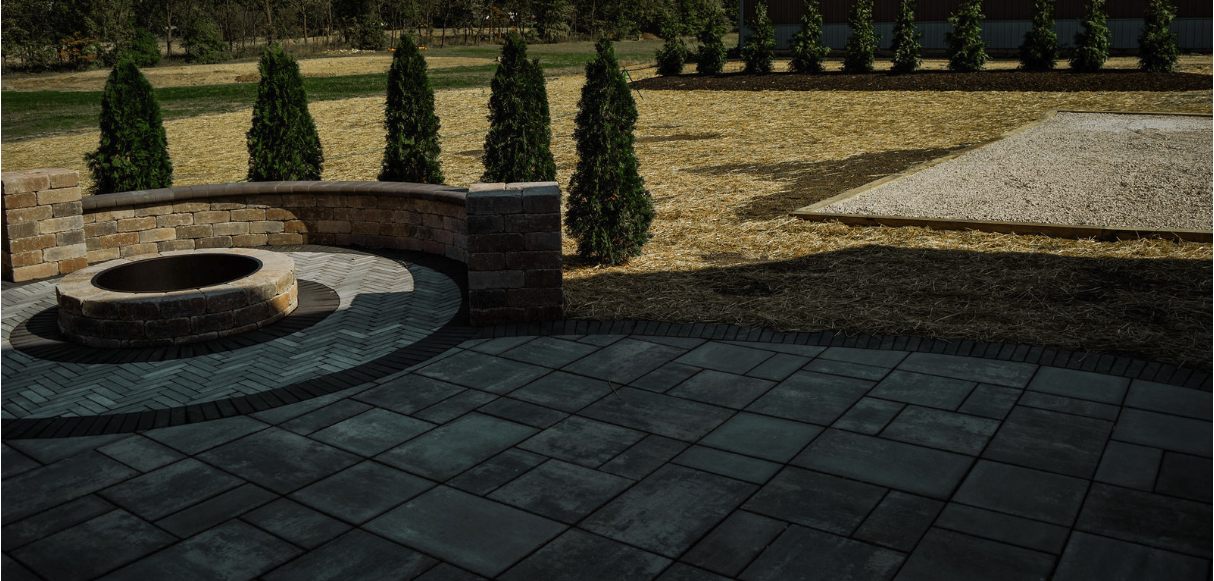
- Medium patio — $15,000 to $50,000. Around 16×24 and up. Premium pavers, borders, curves, often a step or seating wall.
- Large patio and outdoor living projects — $50,000 to $150,000+. Multi-zone patios with fire features, walls, lighting, and full outdoor living spaces.
If you need a firm price, request a consultation so I can view your potential project, listen to your ideas, and determine the actual scope of work required. Estimates are always free, and I’ll give you a straight answer on what it takes and what it costs. I don’t oversell and I don’t cut corners.
What Actually Drives Paver Patio Cost in Canton
Two patios with the same square footage can be thousands of dollars apart. Here’s why.
Size — but not the way you’d think
Bigger costs more, obviously. But price per square foot usually drops as the patio grows, because the expensive parts — mobilizing equipment, excavation setup, hauling — get spread across more area. A 400 sq ft patio is not simply double the price of a 200 sq ft patio. If you’re on the fence between two sizes, ask me to quote both. The difference is often smaller than homeowners expect.
Paver material and brand
This is the biggest material swing. Standard concrete pavers, premium lines from Unilock, Belgard, or Techo-Bloc, clay brick, and natural stone all install differently and price differently. Full table below.
Base preparation
Every patio I build gets a 5-inch compacted open graded base. That spec is not negotiable, and it’s where a real chunk of your money goes — excavation, stone, and compaction you’ll never see once the pavers are down. It’s also the single biggest difference between a patio that’s flat in 15 years and one that’s a rolling mess in two. More on Canton’s soil below, because this is the part of the estimate you should be asking every contractor about.
Site access
If my skid steer can drive straight to your backyard, excavation is fast. If your patio site is behind a fenced yard off Fulton Drive with a gate too narrow for equipment, material moves by wheelbarrow — and labor hours climb. Tight access on older Canton lots near Stadium Park or in the West Park streets can add 10–20% to a project.
Tear-out and demolition
Removing an existing cracked concrete slab, an old failed paver patio, or a rotted deck adds demo labor and disposal fees. I’ve torn out plenty of heaved concrete slabs behind 1950s and 60s ranches in Perry Township — that concrete is heavy, and it has to go somewhere.
Drainage needs
If water already sits where the patio is going, we fix that first. That might mean regrading, a drain line, or a full drainage solution tied into the patio build. Skipping this step to save money is how you end up with a skating rink in January and shifting pavers in April.
Patterns, borders, steps, and extras
Herringbone and running-bond patterns cut faster than circles and fans. Contrasting borders, inlays, steps, seat walls, columns, and fire pits all add real material and real labor. They’re also what turns a slab of pavers into a space you actually want to sit in — I just want you to know where the dollars are going.
Paver Material Pricing Table (Installed, Canton Area)
| Paver Material | Installed Cost per Sq Ft | Notes |
|---|---|---|
| Standard concrete pavers | $12 – $18 | Best value; solid freeze-thaw performance |
| Premium concrete pavers (Unilock, Belgard, Techo-Bloc) | $16 – $25 | Better textures, colors, and warranties on the product itself |
| Permeable pavers | $16 – $28 | Deeper stone base; excellent for wet Canton lots |
| Clay brick pavers | $18 – $30 | Classic look; colorfast for decades |
| Natural stone (bluestone, flagstone) | $25 – $35+ | Premium look, premium labor |
For price grounding: Stone Center, the Columbus-area supplier whose 2025 pricing guide currently tops the Ohio search results, publishes the same $12–$35/sq ft installed range and a typical project of $8,500–$18,500 statewide. My numbers line up with theirs because that’s what honest paver work costs in Ohio right now. Anyone quoting you $8/sq ft installed is cutting the base, cutting the labor, or both.
Why Base Prep Is the Make-or-Break Cost in Canton
Northeast Ohio’s heavy clay soil is unforgiving. It compacts, it holds water, it cracks in drought, and it destroys cheap hardscaping. Canton sits in USDA Zone 6a, which means the ground under your patio freezes and thaws dozens of times every winter. Every one of those cycles, water trapped in that clay expands and pushes on whatever is sitting above it.
A paver patio that wasn’t built with the right base depth and compaction will start shifting and sinking within two winters. I’ve rebuilt enough of them across Stark County to prove the point — patios behind homes near Meyers Lake and in Avondale where a low bidder threw down two inches of limestone screenings over topsoil, ran a compactor over it once, and called it a base. By the second spring, the corners had dropped, the joints had opened up, and the homeowner was paying twice: once for the cheap patio, once for me to tear it out and build it correctly.
The open graded base I use handles clay differently. Instead of a dense sand-and-fines base that traps water against the clay, angular open graded stone lets water pass through and drain away from the surface, so freeze-thaw has far less to grab. Combined with proper excavation depth, geotextile fabric where the soil calls for it, compaction in lifts, and correct pitch away from your foundation, that’s what a patio built to last looks like. You can read the full process on my paver patio construction page.
So when you’re comparing quotes, don’t compare bottom lines — compare base specs. Ask every contractor three questions: How deep is the excavation? What base material and how is it compacted? How are you handling drainage? If the answers are vague, the low price is coming out of the part of the patio you can’t see.
What’s Included in a Fili Property Maintenance Patio Quote
When I hand you a number, here’s what’s behind it:
- Design and layout — I personally assess the property, shoot grades, and plan the patio around how you’ll actually use it, not just where it’s easiest to build.
- Excavation and haul-off — digging to proper depth and removing the spoils.
- The 5-inch compacted open graded base — stone, fabric where needed, compaction in lifts.
- Pavers, edge restraint, and jointing — the material you picked, installed in the pattern you picked, with concrete or spiked edge restraint and polymeric sand joints.
- Grading and drainage tie-ins — correct pitch, and drain work scoped up front if your site needs it.
- Cleanup and final walkthrough — I oversee every installation from the initial consultation to the final walkthrough, and I don’t subcontract your work out to whoever shows up.
No allowances that mysteriously balloon later, no “site conditions” surprise line items for things I could have seen at the consultation.
Where Homeowners Waste Money — and Where You Should Never Cheap Out
Fine places to save:
- Shape. A clean rectangle installs faster than sweeping curves and cuts less waste off every paver.
- Pattern. Running bond or herringbone over circle kits and inlays.
- Phasing. Build the patio with a proper base now; add the seat wall, pergola, or lighting next season. I design for it so nothing gets torn up later.
- Paver line, within reason. A standard paver over a proper base beats a premium paver over a bad one every single time.
Never cheap out on:
- The base. Everything above says why. This is the patio.
- Drainage. Water problems don’t age well, and they’re far cheaper to solve before the pavers go down.
- Edge restraint and jointing. Skip these and the border creeps, joints wash out, and weeds move in.
- The installer. My 4.9 Google rating and 140+ reviews didn’t happen by accident. The gap between the low bid and a correct bid is usually about two years of Ohio winters.
A well-built paver patio is also one of the better-returning hardscaping installations you can put into a Canton home — it’s usable space, it’s curb appeal, and unlike a cheap slab, it doesn’t become a liability line on your inspection report when you sell.
Paver Patio Cost FAQs
Do you offer financing on paver patios?
Yes — I have financing options available for patio projects. We’ll go over them at your consultation and find the structure that fits your budget and project size. What I won’t do is inflate the price to bury a “free financing” gimmick in it, the way some of the bigger outfits do. The estimate itself is always free.
How long does a paver patio take to install?
Most small-to-medium patios take 3 to 7 working days once we start — excavation and base are the bulk of it, and I don’t rush the compaction. Larger projects with walls, steps, or fire features run one to three weeks. Weather in Northeast Ohio gets a vote, so I build a little slack into every schedule and keep you posted.
Do I need a permit for a paver patio in Canton?
A basic ground-level paver patio typically doesn’t require a building permit in Canton or most Stark County townships. Where it changes: seat walls over a certain height, structures like pavilions, gas lines to fire features, or work affecting drainage easements. I confirm requirements with the local building department for your specific address as part of the project — you’re not left guessing.
Is it cheaper to build a patio in the fall?
Sometimes, yes. My spring schedule fills fastest, so late-season and shoulder-season slots can come with more scheduling flexibility and occasionally better pricing on materials. Fall installs are also great for the patio itself — the base gets a full winter to prove itself before your first cookout. Book by late summer if you want a fall slot; I can’t pour base into frozen ground.
Are pavers more expensive than a concrete patio?
Up front, yes: pavers run $12–$35/sq ft installed versus roughly $6–$15 for a poured slab. But Canton’s clay and freeze-thaw cycles crack concrete slabs — it’s not if, it’s when — and a cracked slab is a tear-out. Pavers flex with the ground, and if one ever settles, I can lift and relay that section instead of demolishing the whole thing. Over 15–20 Ohio winters, the paver patio is usually the cheaper structure.
How long will a paver patio last in Northeast Ohio?
Built on a proper compacted base with real edge restraint: decades. The pavers themselves are rated far beyond that. What fails is bad prep — which is why every question in this post keeps coming back to the base.
Get a Straight Answer on Your Canton Patio
Transform your Canton property with a paver patio that’s built for Stark County clay and Ohio winters — real outdoor living space that adds curb appeal and property value instead of becoming a repair project. Whether you’re in Ridgewood, Hills and Dales, Avondale, or anywhere across Stark County, I’ll walk your site, listen to your ideas, and give you honest numbers. See everything else I build in the area on my Canton landscaping page.
Call (330) 904-4196 now for your free Canton paver patio estimate.
Or fill out our online contact form and I’ll respond the same day (usually within hours).
Fili Property Maintenance · (330) 904-4196 · info@filipropmaint.com · 5928 Mann St NE, Louisville, OH 44641
Get Your Free Quote
Fili Property Maintenance serves Canton, North Canton, Louisville and the surrounding Stark and Summit County communities. Call or text (330) 904-4196, or send the form below and we will get right back to you.