How Much Does a Retaining Wall Cost in Ohio?
A professionally built block retaining wall in Northeast Ohio costs $40–$95 per square foot installed. For the standard 3-to-4-foot wall most homeowners need, that’s $150–$400 per linear foot, and a typical 40-to-60-foot wall with proper drainage and geogrid lands between $10,000 and $25,000. Small garden walls under 2 feet run $3,000–$6,000 — job minimums are real — and large, tiered, or engineered walls run $30,000 to $100,000 and up. If you’ve seen $20–$55 per square foot online, I’ll show you below exactly why those numbers don’t survive contact with a real Northeast Ohio job site.
I’m Jordan Filimonuk, owner of Fili Property Maintenance, and I’ve spent over 15 years designing, building, and maintaining landscapes across Northeast Ohio — including a lot of retaining walls, and more than a few rebuilds of walls that other companies got wrong. I’m based in Louisville, and I build walls throughout Stark and Summit County: Canton, North Canton, Massillon, Alliance, Akron, Hudson, and everywhere in between. My 4.9 Google rating and 140+ reviews didn’t happen by accident. I don’t subcontract your work out to whoever shows up, and when you ask me what a wall costs, I’ll give you a straight answer on what it takes and what it costs.
That last part matters, because retaining walls are one of the easiest projects in landscaping to underbid. A cheap wall and a correct wall can look identical the day they’re finished. The difference shows up two or three winters later, when the cheap one starts leaning. So let’s talk real numbers — and what those numbers actually buy you.
What Actually Drives Retaining Wall Cost
Two walls of the same length can be tens of thousands of dollars apart. Here’s why.
Height — the biggest single factor
Cost doesn’t climb in a straight line with height. It climbs in a curve. A small garden wall under 2 feet is a $3,000–$6,000 project — excavation, base gravel, drainage, and a crew showing up cost real money no matter how short the wall is. A 3-to-4-foot wall holding back a slope runs $150–$400 per linear foot built correctly. Push past 4 feet and you’re often at $250–$500 per linear foot — and into engineering territory.
Here’s the rule most homeowners don’t know: once a wall exceeds 4 feet of exposed height, it should be designed by an engineer, and many Ohio municipalities require it. Stamped plans typically add $1,500–$3,500. And from about 3 feet up, the wall needs geogrid reinforcement — layers of soil mesh tied back into the compacted fill — because the soil pressure behind a wall grows fast with every course you add. That’s not me upselling you. That’s physics, and it’s the building code in most of Stark and Summit County. If a contractor quotes you a 6-foot gravity wall with no geogrid and no engineering, walk away. I’ve rebuilt those walls, and the rebuild always costs more than doing it right would have.
Length
Straightforward per-foot math, with one wrinkle: longer walls get slightly cheaper per foot because mobilization, excavation setup, and material delivery get spread over more wall. A 100-foot wall is not double the cost of a 50-foot wall — it’s usually a bit less.
Material
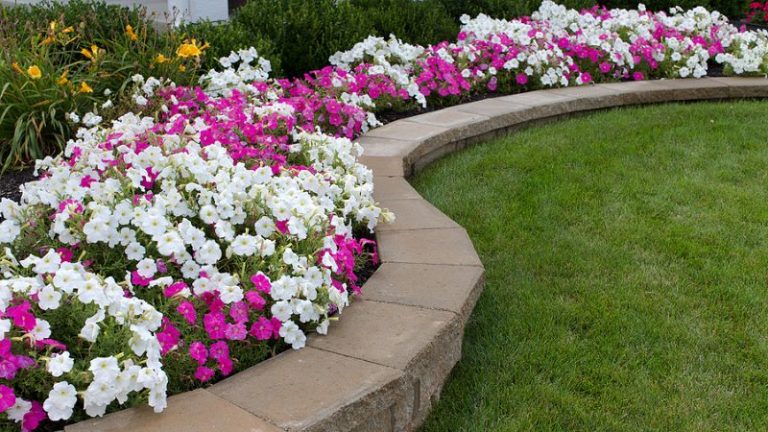
Segmental concrete block (the Allan Block and Versa-Lok style systems) is the workhorse — engineered, consistent, and built for our climate. Natural stone costs more per square foot and more in labor, because every stone gets fitted by hand. Timber is the cheapest up front and the shortest-lived in Ohio’s wet clay — pressure-treated ties in constantly damp soil have a fraction of the lifespan of block or stone. Full pricing table below.
Drainage behind the wall — the #1 corner cheap builders cut
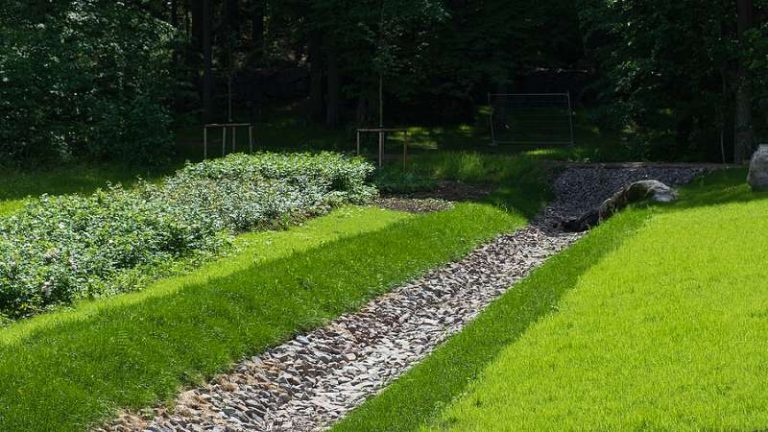
This is the one I want you to remember. Every proper retaining wall needs a column of clean angular gravel behind it and a perforated drain pipe at the base, piped to daylight. In our clay, that drainage package runs $55–$90 per linear foot of wall — and it’s invisible the day the wall is finished, which is exactly why cheap builders skip it, and skipping it is the #1 reason walls in Northeast Ohio lean, bulge, and fail. Water trapped behind a wall in clay soil doesn’t just sit there. It pushes. More on that in a minute, because around here it’s not optional.
Site access, excavation, and tear-out
A wall in an open front yard where I can get a skid steer to the dig is one price. A wall in a fenced backyard on a slope, where material moves by wheelbarrow and track machine, is another. Excavation conditions matter too — cutting into a compacted clay bank takes more time than reshaping loose fill, and every wall gets a dug, compacted gravel base trench below grade before the first block is set. And if a failing wall already stands where the new one goes, tear-out and haul-off adds $10–$35 per square foot before new construction starts. If your project involves significant earth moving, that’s work I handle in-house as part of my property grading service, not a line item I farm out.
Retaining Wall Cost by Type in Ohio
| Wall type | Installed cost per sq ft | Best for | Expected lifespan in NE Ohio |
|---|---|---|---|
| Segmental concrete block (SRW) | $40–$95 | Most residential walls; slopes, terraces, driveways | 50+ years built right |
| Poured concrete | $50–$90 | Modern look, structural applications | 50+ years, but cracks are hard to fix |
| Natural stone (dry-stacked fieldstone) | $60–$100 | Garden walls, rustic borders under 3 ft | Decades; individual stones resettable |
| Natural stone (mortared/cut stone) | $80–$120+ | High-end landscapes, premium curb appeal | 50+ years with good footing |
| Pressure-treated timber | $25–$45 | Budget walls, short-term fixes | 15–20 years, less in wet clay |
Quick math for budgeting: a 50-foot wall averaging 3.5 feet tall is 175 square feet of wall face. At $60–$95 per square foot with the drainage and geogrid a wall that size needs, that’s roughly $10,500–$16,500 — exactly how a typical 40-to-60-foot wall lands in the $10,000–$25,000 range. Those are the same tiers I publish on my retaining wall construction page — smaller garden walls $3,000–$5,000, medium walls up to 4 feet $10,000–$25,000, large or tiered walls $30,000–$100,000+ — the same numbers, because they’re the same walls. If a bid comes in dramatically under these figures, something in the ground is being skipped.
Why the Numbers You Found Online Look So Much Cheaper
Search “retaining wall cost” and you’ll find national guides quoting $20–$55 per square foot and average projects around $6,000. Even Stone Center, the Columbus stone supplier whose Ohio cost guide ranks for this exact question, repeats that framework. So why is my quote — and every real Ohio contractor’s quote — higher? Because those guide numbers describe one specific wall: short, low, straight, easy machine access, nothing to tear out, no engineering, no real drainage package. That wall exists. It’s just not the wall on your property.
The guide math leaves out everything that dominates a real Northeast Ohio quote: $55–$90 per linear foot of clay-soil drainage, geogrid from about 3 feet up, $1,500–$3,500 in stamped engineering above 4 feet, $10–$35 per square foot to tear out the failing wall that’s usually already there. Stack those on and the “cheap” wall doubles or triples. The Ohio contractors who publish real installed pricing land right where I do — one Cincinnati design-build firm tells prospects to expect $75–$95 per face foot. So when an online calculator says $5,000 and I say $15,000, we’re not disagreeing about price. We’re describing two different walls — and only one of them is still standing in ten years.
Why Northeast Ohio Destroys Cheap Retaining Walls
Northeast Ohio’s heavy clay soil is unforgiving. It compacts, it holds water, it swells when wet, and it destroys cheap hardscaping. Add our Zone 6a freeze-thaw cycles — dozens of them every winter, not one long freeze — and you have the exact conditions retaining walls hate most.
Here’s the failure sequence I see over and over: a wall gets built with the excavated clay shoved right back behind the blocks instead of clean gravel. Fall rains saturate that clay. Winter freezes it. Frozen, water-heavy clay expands and shoves the wall forward an eighth of an inch. It thaws, the clay slumps and resettles, and the next freeze shoves it again. Multiply that by thirty freeze-thaw cycles a winter and by a few winters, and you get the leaning, bellied-out walls you see all over Canton and Akron — walls that are maybe eight years old and already done.
I’ve rebuilt plenty of other companies’ walls across Stark County to prove that point, from sloped backyards in North Canton to older properties around Ridgewood and Hills and Dales in Canton, where 1950s-era timber and block walls are failing in batches. In almost every teardown, I find the same two missing ingredients: no gravel backfill column, no base drain. The blocks were fine. The ground behind them was never handled.
That’s why every wall I build gets a compacted angular-gravel base below grade, a full clean-gravel drainage zone behind the wall, perforated pipe at the footing daylighted away from the wall, and geogrid reinforcement wherever height or surcharge calls for it. If surface water is part of your problem — and on a lot of sloped properties it is — I’ll often pair the wall with broader drainage solutions so the wall isn’t fighting your whole yard’s runoff by itself. You can see my full wall-building process on my retaining wall construction page.
Do You Actually Need a Retaining Wall? The Regrading Alternative
Here’s something a wall salesman won’t tell you: some slopes don’t need a wall at all. If your grade change is gentle — a couple of feet across a decent run — regrading the slope and stabilizing it with plantings or turf is often thousands of dollars cheaper than building a wall to hold it. Regrading typically runs a fraction of wall cost, fixes drainage problems at the source, and gives you usable lawn instead of a structure to maintain.
A wall earns its cost when the grade change is steep or tall, when you need flat usable space — a patio terrace, a driveway edge, a level backyard — or when the slope is actively eroding toward your foundation. When I come out for an estimate, I’ll tell you honestly which situation you’re in. I don’t oversell and I don’t cut corners. If a $3,000 regrade solves what a $15,000 wall would, you’ll hear that from me, because that’s how you end up with 140+ five-star reviews instead of 130 walls people regret.
And if the wall is part of a bigger outdoor project — terraced patio, steps, seat walls — it usually pays to design it all at once as a single hardscaping installation so the grades, drainage, and materials work together instead of getting bolted on piecemeal.
What’s in a Fili Retaining Wall Quote
When I quote a wall, you get one number that covers the whole job — not a teaser price with the important parts missing. Every Fili retaining wall quote includes:
- Site assessment and layout — I personally walk the site, check the grades and drainage patterns, and mark the wall line. I’m the one who assesses it, and I’m the one who oversees the build.
- Excavation and base preparation — dug base trench below grade, compacted angular gravel footing. The wall stands on this, so it doesn’t get skipped or skimped.
- Wall material and construction — the block or stone system we agreed on, batter (setback) built into every course, caps adhered.
- Drainage package — clean gravel backfill column, perforated base drain, piped to daylight. In writing, on every quote.
- Geogrid and engineering where required — included and itemized for taller walls, never “discovered” mid-job as a change order.
- Backfill, compaction, and cleanup — soil placed and compacted in lifts behind the drainage zone, site graded smooth, spoils hauled off.
Estimates are always free. If you need a firm price, request a consultation so I can view your slope, listen to what you want out of the space, and determine the actual scope of work — because with retaining walls, the scope lives in the ground, not on a satellite photo.
Retaining Wall Cost FAQ
Do I need a permit for a retaining wall in Ohio?
Usually not for walls under 4 feet, but it varies by municipality — Canton, North Canton, Akron, and the townships each have their own thresholds, and walls supporting a driveway or structure can need a permit at any height. I check the requirements for your specific address before we build, and if a permit is needed, I handle it.
When does a wall need an engineer?
Any wall over 4 feet of exposed height should be engineered, and most local codes require a stamped design at that point. Figure $1,500–$3,500 for stamped plans. Walls under 4 feet that carry a surcharge — a driveway, a slope, or a structure pushing on them from above — deserve engineering too. It’s a small line item on a project that size, and it’s the difference between a wall and a liability.
How long does a retaining wall last in Northeast Ohio?
A segmental block or stone wall built with a compacted base, gravel backfill, and a working drain will go 50 years and more — the block manufacturers’ materials outlast most houses’ owners. A wall built without drainage in our clay typically starts leaning within 5–10 years. Timber walls are shorter-lived regardless: figure 15–20 years, less where the soil stays wet.
My wall is leaning — repair or rebuild?
Depends on why it’s leaning. If a few blocks have shifted but the base is sound, sections can sometimes be reset. But if the wall is leaning because there’s saturated clay and no drainage behind it — which is what I find in the majority of the failing walls I look at — resetting the face is a bandage. The wall needs to come down — tear-out alone runs $10–$35 per square foot — the drainage goes in, and the wall gets rebuilt, usually with the same blocks if they’re an engineered system in good shape. Reusing the block is a real cost saver on rebuilds, and I’ll tell you up front which situation you have.
What’s the best retaining wall material for Ohio’s climate?
For most residential walls: segmental concrete block, no contest. The units are engineered for freeze-thaw, the flexible joints move a hair and resettle instead of cracking the way rigid poured walls can, and the price-to-lifespan ratio beats everything else on the table above. Natural stone is the right call when the landscape demands the look and the budget supports it. Timber I’ll build if you ask, but I’ll tell you what you’re trading for the lower price.
Does a retaining wall add property value?
A well-built one does — it converts unusable slope into flat, functional yard, controls erosion, and reads as quality from the curb, which matters in neighborhoods like North Canton’s where buyers notice the difference between a crisp wall and a leaning one. A failing wall does the opposite: it’s one of the first things a home inspector flags.
Get a Straight Answer on Your Wall
Transform that slope from a problem you mow sideways into flat, usable, erosion-proof space that adds real value to your property. Whether you’re in Louisville, Canton, North Canton, Massillon, Akron, or anywhere in between, I’ll look at your grade, give you honest numbers — wall, regrade, or both — and build it the way Northeast Ohio’s clay and winters demand.
Call (330) 904-4196 now for your free retaining wall estimate.
Or fill out our online contact form and I’ll respond the same day (usually within hours).
Fili Property Maintenance · (330) 904-4196 · info@filipropmaint.com · 5928 Mann St NE, Louisville, OH 44641
Get Your Free Quote
Fili Property Maintenance serves Canton, North Canton, Louisville and the surrounding Stark and Summit County communities. Call or text (330) 904-4196, or send the form below and we will get right back to you.